To keep kids cool at a bounce house party in Florida, book the unit for the morning (before about 1 p.m.), set it up in shade, and put a water station or water slide right next to it. The vinyl inside an inflatable runs 8 to 10 degrees hotter than the air outside, so on a 92-degree Orlando afternoon the inside can sit near 100. Short jump sessions, cold water, and a wet unit instead of a dry one are what actually keep a party going in July.
I've set up inflatables in Apopka driveways where the asphalt was hot enough to feel through my shoes by 11 a.m. One July birthday, a mom had booked a dry bounce house for 2 p.m. and by the second song the kids were done — flushed, cranky, and parked under the carport. That party taught me a lesson I now give every summer customer: in Central Florida, the heat is the thing you plan around first. Everything else is details. Here's exactly how we keep kids cool, safe, and actually bouncing when it's hot out.
How hot does a bounce house get?
The inside of a bounce house is hotter than the yard it's sitting in. A University of Georgia study led by meteorologist Marshall Shepherd put sensors inside and outside an inflatable over two July days when the outdoor temperature topped 90 degrees, and found the inside ran 8 to 10 degrees hotter at the hottest part of the day. The vinyl absorbs sun, a blower is pushing in outside air, and a dozen kids are generating body heat in an enclosed space.
Now layer on Orlando. Our average daily high is 91 in June, 92 in July, 92 in August, and 90 in September (NOAA 1991–2020 normals). Do the simple math: 92 outside plus an 8-to-10-degree bump means the inside of a dry unit can sit around 100 to 102 degrees by mid-afternoon, before humidity even enters the picture.
What temperature is too hot for a bounce house?
There's no legal cutoff, but the honest answer is that the "feels like" number matters more than the thermometer. The National Weather Service heat index combines air temperature with humidity, and in full sun it can read up to 15 degrees higher than a shady-spot reading. At 96 degrees with 65% humidity — a normal Central Florida summer afternoon — that heat index hits 121. That's the range where prolonged activity brings on heat cramps and exhaustion.
My rule of thumb after years of summer deliveries: once the heat index pushes past 100, a dry bounce house in direct sun stops being fun fast. That doesn't mean cancel. It means change the setup — shade it, shorten the sessions, add water.
Why kids overheat faster than adults
This is the part parents underestimate. Children's bodies ramp up sweat production more slowly than adults', so they adjust to heat more slowly. A larger share of a child's body weight is water, which makes them more prone to dehydration, and younger kids often don't notice or say when they need a drink — so they rely on the adults around them to call the water break (pediatric heat-safety guidance). On a bounce house, where kids are running at full effort and don't want to stop, that is exactly how a fun afternoon turns into a meltdown.
Learn the early signs of heat exhaustion: a flushed face, headache, dizziness, cramps, and heavy sweating. Move the child to shade, give cool fluids, and cool them down with a wet towel. A body temperature over 104 degrees is heatstroke and a 911 call — but you rarely get near that if you're doing the basics below.
The 7 things that actually keep kids cool
- Book the morning slot. The single biggest lever. A 9 or 10 a.m. start beats the worst of the heat and usually beats the afternoon thunderstorms we get all summer. We fill our summer Saturday schedule with morning deliveries first for exactly this reason.
- Put it in the shade. A unit under a big oak or on the shaded side of the house runs noticeably cooler than one baking in open sun. If there's no natural shade, a couple of pop-up canopies over the entrance and a rest area do a lot.
- Go wet, not dry. From June through September, a water slide rental or a wet/dry combo is the move. Water pulls heat off kids instantly and the party lasts twice as long. It's the number-one reason our water slides outbook dry units all summer.
- Set a water station they'll actually use. A cooler of cold water bottles and popsicles right at the exit of the unit, not across the yard, so a water break is three steps instead of a negotiation.
- Rotate kids in shifts. Smaller groups, shorter turns. Ten minutes in, a water break, rotate. It keeps the inside from packing with body heat and gives everyone a breather.
- Dress for it. Light-colored, lightweight clothes, and swimsuits if there's a water unit. Skip the heavy costume if it's a themed party at peak heat — save the cape for photos.
- Watch the surface, not just the air. If the vinyl steps or the slide are too hot to hold your hand on comfortably, they're too hot for bare feet and legs. A quick hose-down cools the surface and doubles as fun.
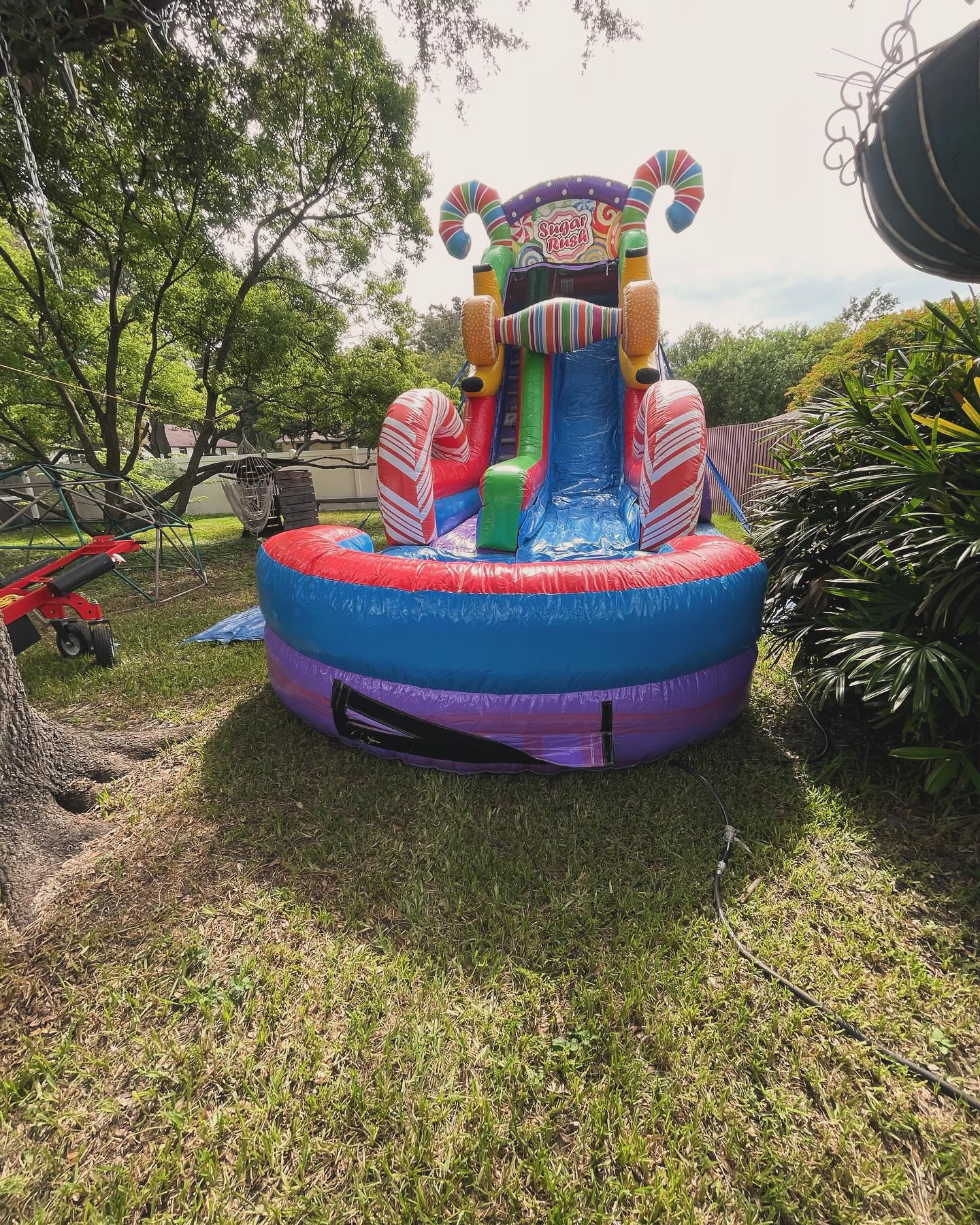
A wet/dry water slide is our most-booked unit from June through September — it keeps kids cool and the party running longer.
Dry bounce house vs. water slide in Florida summer
When a customer calls in July undecided, this is the comparison I walk them through. If your party lands between May and October in Central Florida, I steer almost everyone toward a wet option — you can always run a wet/dry combo dry, but you can't make a dry unit wet.
| Option | Best for | Setup needs | Summer verdict |
|---|---|---|---|
| Dry bounce house | Cooler months, indoor venues, shaded morning-only parties | Lowest — no hose | Heats up; shorter usable afternoon window |
| Wet/dry combo | Most parties — start dry, add water as it heats up | Hose + a spot that drains | Most flexible; our most-booked summer unit |
| Water slide | Peak summer, pool-party energy, kids old enough to slide | Water source + wet landing (grass beats concrete) | Keeps kids coolest, party longest |
A few Florida-specific things we plan around
Afternoon storms
Our summer pattern is sun in the morning and thunderstorms around 2 to 4 p.m. Morning parties dodge both the peak heat and the lightning, and we take down units at the first thunder, no exceptions.
The sun moves
The shady corner at 10 a.m. is in full sun by 1. We place units for where the sun will be during the party, not where it is when we pull up.
Power and placement
A blower runs the whole time, which is why a shaded, level grass spot near an outlet (or one of our generators) beats a sunny slab. And if you're wondering whether the unit will hurt your lawn, a morning party on grass is fine. Still deciding between water and no water? Our guide on wet vs. dry bounce houses breaks it down by age and yard.
Key takeaways
- Inside a bounce house runs 8 to 10 degrees hotter than outside — at Orlando's 92-degree July norm that's about 100 inside by afternoon.
- The heat index (temperature + humidity) is what matters, and full sun adds up to 15 degrees.
- Kids overheat faster than adults and rely on you to call the water breaks.
- Morning setup, shade, a wet unit, and a close water station is the whole playbook.
- Between May and October in Central Florida, book a water slide or a wet/dry combo.
Frequently asked questions
How hot does a bounce house get inside?
About 8 to 10 degrees hotter than the outside air on a hot day, per a University of Georgia sensor study. On a typical 92-degree Orlando afternoon that puts the inside near 100 degrees before you factor in humidity.
What temperature is too hot for a bounce house?
There's no official cutoff, but once the heat index climbs past about 100 degrees, a dry unit in full sun gets uncomfortable fast. Move it to shade, shorten jump sessions, and add water rather than canceling.
Is it safe to have a bounce house in 90-degree weather?
Yes, with precautions. Set up in shade, keep cold water right at the exit, rotate kids in shorter shifts, and watch for flushed faces or dizziness. A wet unit makes 90-degree days easy.
Should I get a water slide instead of a bounce house in summer?
In Central Florida, between roughly May and October, yes. A water slide or wet/dry combo keeps kids far cooler and the party lasts longer. A combo lets you start dry in the morning and turn the water on as it heats up.
What's the best time of day for a summer bounce house party?
Morning. A 9 or 10 a.m. start beats both the peak afternoon heat and the daily summer thunderstorms Central Florida gets from about 2 to 4 p.m.
How do I keep the bounce house itself cooler?
Shade is the biggest factor: set up under a tree or on the shaded side of the house, add a canopy if there's no natural shade, and hose down hot vinyl surfaces. Placing it for where the sun will be during the party, not where it is at setup, matters more than people expect.
Do you deliver cooling-friendly units around Orlando?
Yes. We're a family-owned company in Apopka and we deliver bounce houses, water slides, and wet/dry combos across Orlando, Winter Garden, Mount Dora, Eustis, and the surrounding Central Florida area all summer.
Beat the heat at your next party
Tell us your date and backyard and we'll match you to the right wet or dry unit — delivered, set up, and cleaned by our family.
See water slide rentals
Tommie Parker is the owner of Too The Moon Bounce Co, a family-owned bounce house and water slide rental company in Apopka, FL serving Orlando and Central Florida. He and his family deliver, set up, and clean every unit themselves.