Published September 24, 2026 · 7 min read
Never run a bounce house in winds stronger than 15 to 25 mph — that is the ceiling the U.S. Consumer Product Safety Commission (CPSC) gives. In practice, most professional operators (us included) start shutting down at the low end of that range, around 15–20 mph sustained wind, and we watch gusts even more closely than the steady wind. If the tops of the trees are swaying, it's already too windy to let kids inside.
Every Central Florida parent has watched a clear-blue morning turn into a gusty afternoon in about twenty minutes. So it's a fair question, and one we get on the phone constantly: exactly how much wind is too much before a bounce house stops being fun and starts being dangerous? Here's the number, the reason it's lower than most people think, and what actually happens on our end when the forecast gets iffy.
Figures from the U.S. CPSC and a 2022 analysis in the Bulletin of the American Meteorological Society (both linked below).
On this page
What wind speed is too much for a bounce house?
A bounce house should not be used once winds reach 15 to 25 mph. The CPSC states plainly that "maximum wind speed should be no more than 15 to 25 mph if you are using a bounce house," and warns that an unsecured unit can be sent airborne by a single gust. Where a specific unit falls in that 15–25 range depends on its size, how it's anchored, and the manufacturer's own rating — and the manufacturer's number always wins if it's lower.
Here's how we read the wind at a job, and it's the same scale we'd tell any parent to use:
| Sustained wind | What it means | What we do |
|---|---|---|
| Under 10 mph | Safe, normal operating range | Party on — standard anchoring |
| 10–15 mph | Getting breezy; watch the gusts | Extra anchoring, keep watching the sky |
| 15–20 mph | Caution zone, the CPSC's floor | Clear the unit, reassess, often shut down |
| 20–25 mph or gusting higher | Danger, at or past the limit | Everyone out, blower off, deflate |
Notice the caution zone starts at 15, not 25. The 25 mph figure is a hard ceiling, not a target. Treating it like the "okay until then" line is how people get hurt.
Why is even a light breeze dangerous for a bounce house?
Because a bounce house is basically a giant, lightweight sail, and it doesn't take much wind to move one. A 2022 analysis published in the Bulletin of the American Meteorological Society reviewed 132 wind-related bounce house incidents in the U.S. between 2000 and 2021 and tied them to at least 28 deaths and 479 injuries. The part that surprises people is that about a fifth of those incidents struck in winds under 15 mph, and roughly half happened under 25 mph. One wind engineer in that work calculated that a gust of about 22 mph can lift an inflated, anchored, occupied unit off the ground.
That's the whole reason we're careful at numbers that sound harmless. A steady 12 mph breeze with a 20 mph gust behind it is exactly the condition that has flipped units at real parties. The CPSC also flags a simpler warning sign: "if the tops of the trees are swaying, it may be too windy to let your child play inside of a bounce house." You don't need a weather degree — you need to look up.
How do you tell when it's too windy?
You use three things: a forecast, your eyes, and ideally a cheap wind meter. Before we ever load the trailer, we check the hourly forecast for both sustained wind and gust speed, because gusts are what do the damage, and a lot of weather apps bury them a tap deep. On site, the tree test is the fast read: leaves rustling is fine, small branches and treetops swaying is your cue to stop.
Gusts, not steady wind, are the real number. A forecast that says "10 mph winds" can still throw 25 mph gusts. Always look at the gust line, not just the steady wind number, because that is what decides whether a unit stays anchored.
If you want to be exact, a handheld anemometer costs about $20 and takes the guesswork out. We carry one, and we'll happily tell you the reading at your address rather than argue about how it "feels."
What we do before every Central Florida setup
This is the part a lot of renters never see, and it's where we earn the "fully insured, on-time" line. Our wind rule is simple and we don't bend it: if sustained winds or forecast gusts are pushing past the safe range for your unit, the party gets a weather hold or a reschedule, not a "let's risk it." Specifically, on every setup we:
- Check the morning and hourly gust forecast for your exact city, from Apopka to Winter Garden to Mount Dora — not just "Orlando."
- Anchor to the surface the right way: long steel stakes driven at every anchor point on grass, or heavy sandbags (the kind that actually weigh 25–40 lbs each, not two token bags on the corners) when we set up on concrete or a driveway, per the unit's manufacturer and the ASTM F2374 safety standard for inflatable devices.
- Walk you through the shut-down plan at drop-off, so an adult on site knows exactly what to do if the sky changes while we're at the next job.
- Stay reachable. If a storm line is coming, we're already watching the radar for you.
We'd rather move your date than explain to a parent why a unit tumbled across the yard. That's not us being dramatic; it's the whole reason we keep our safety guidelines tight.
What should you do if the wind picks up during your party?
Get everyone out first, then deal with the unit, in that order, every time. If the wind climbs into the caution zone mid-party, here's the sequence we teach every customer at drop-off:
- Clear the kids out immediately and move them a safe distance away from the inflatable.
- Turn off the blower so the unit deflates and lies flat — a deflated unit can't catch wind.
- Do not try to hold it down. Adults have been injured grabbing units in gusts. Let it deflate; it's just fabric.
- Wait it out. Florida gust fronts often pass in 20–40 minutes. Once it's calm and the unit is dry, we can get you bouncing again.
- Call us. If you're not sure, that's what the number's for, and we'll make the call with you.
The Florida factor: storms, sea breeze, and gust fronts
Central Florida makes this trickier than most of the country, and it's worth saying out loud. Our summer afternoons run on the sea-breeze collision — two coastlines pushing air inland until it stacks up over Orlando and fires off thunderstorms, often between about 2 and 6 p.m. Those storms don't just bring rain and lightning; the gust front that races out ahead of one can hit 30–40 mph a full ten minutes before the first raindrop. That's the exact "clear sky, sudden gust" setup the safety research keeps flagging.
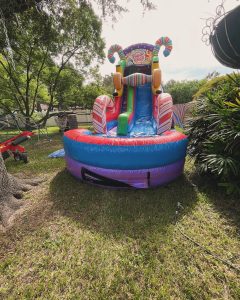
So in the summer we lean toward morning and early-afternoon start times, we keep an eye on the day's storm chances, and for wet-weather months we'll talk through timing with you up front. If you're weighing a water slide rental for a July party, the same wind rules apply — a tall slide is even more of a sail than a standard bouncer. Our Central Florida weather guide goes deeper on rain days and rescheduling.
Key takeaways
- The U.S. CPSC limit for a bounce house is 15–25 mph; treat 15–20 mph sustained as the point to clear the unit.
- Gusts matter more than the steady wind speed. A light breeze with strong gusts is the dangerous combination.
- Per the 2022 AMS analysis, wind-related incidents have caused at least 28 U.S. deaths since 2000, and about a fifth struck in winds under 15 mph.
- The fast field test: if the treetops are swaying, get the kids out.
- If wind picks up: kids out, blower off, don't hold it down, wait it out.
- A reputable, insured local company won't set up — or will reschedule — when the wind is over the line.
Frequently asked questions
Will my bounce house actually blow away?
It can if it isn't anchored right or the wind climbs past the safe range. The CPSC has documented units carried airborne by gusts, and inflatables have been lifted in winds as low as 15 mph. Proper staking or sandbagging plus a hard wind limit is what prevents it — which is exactly what a professional setup gives you.
How windy is too windy for a bounce house?
Once sustained winds reach 15–20 mph, it's time to clear the unit; 25 mph is the absolute ceiling under CPSC guidance. If gusts are pushing into that range even when the steady wind is lower, treat it as too windy.
Can you use a bounce house in 20 mph winds?
You're in the caution-to-danger zone at 20 mph, so the safe answer is no — not with kids inside. Twenty mph is within the range where anchored, occupied units have been lifted. We'd put the unit on hold and wait for it to settle before letting anyone back in.
Do sandbags or stakes really stop a bounce house from blowing away?
They're essential, but they're not a license to run in any weather. Steel stakes on grass or heavy sandbags on hard surfaces hold a unit in normal conditions; once winds pass the manufacturer's limit, even well-anchored units can move. Anchoring plus a wind cutoff is the safe combination — not one or the other.
What happens if it gets windy after you've already set up?
Get everyone out, turn off the blower so the unit deflates, and don't try to hold it down. A flat, deflated unit can't catch the wind. Central Florida gust fronts usually pass in under an hour, and we can restart once it's calm and dry.
Should we still have the party if it's supposed to be windy?
If the forecast shows sustained winds or gusts over the safe range for your unit, we'll move the bounce house to a weather hold or reschedule the date — the rest of the party can still go on. We'd always rather shift the timing than run a unit we're not comfortable with.
Booking with weather peace of mind
We watch the Central Florida forecast so you don't have to. Clean, insured, properly anchored inflatables across Apopka, Orlando and the surrounding suburbs, plus an honest call if the wind won't cooperate.
See our bounce house rentals
Tommie Parker
Owner, Too The Moon Bounce Co
Tommie Parker owns Too The Moon Bounce Co, a family-owned, fully insured bounce house and water slide rental company in Apopka, FL serving Orlando and Central Florida. He and his family deliver, anchor, weather-check, and clean every unit themselves.
Sources: U.S. Consumer Product Safety Commission, "Don't Get Swept Away" (bounce house wind safety guidance); Kennedy et al., "Wind-Related Bounce House Incidents,"Bulletin of the American Meteorological Society (2022); ASTM F2374, Standard Practice for the Design, Manufacture, Operation, and Maintenance of Inflatable Amusement Devices.