By Tommie Parker, Owner · To The Moon Bounce Co
Published September 10, 2026 · 6 min read
Yes, every bounce house needs electricity for the whole party because a blower runs non-stop to keep it inflated. For a standard unit you need one regular 120-volt outlet within about 50 feet. No outlet close enough, like a park or a big open field? You need a generator, and that's something we bring for you.
I'm Tommie Parker. I own To The Moon Bounce Co, and I've set up bounce houses and water slides in backyards, church lots, and parks all over the Apopka and Orlando area. "Where's your nearest outlet?" is one of the first questions my team asks when we're booking, and it trips people up more than you'd think. So here's the whole picture: how the power actually works, how much it costs you (basically nothing), and when a generator comes into play.
Why does a bounce house need power the whole time?
Here's the part people get wrong. The bounce isn't what uses electricity. The blower is.
A bounce house isn't like a pool float you inflate once and seal shut. Air constantly leaks out through the seams and stitching, and that's by design. It's what keeps the walls soft instead of rock-hard. So a blower (basically a big electric fan) sits on the ground and pushes air in continuously to replace what escapes. Cut the power and a full-size bounce house sags to the ground in under a minute. That's also why you never unplug it while kids are inside.
So when someone asks if a bounce house "uses a lot of electricity," the real question is this: how much power does that one blower pull?
How much electricity does a bounce house actually use?
Less than you'd guess. A blower runs on a normal household outlet, and the draw depends on the size of the unit:
| Unit size | Blower | Amps | Power draw |
|---|---|---|---|
| Small / toddler | 1 HP | ~7 amps | ~800 watts |
| Standard | 1.5 HP | ~9 amps | ~1,000 watts (1 kW) |
| Large / combo | 2 HP | ~14 amps | ~1,600 watts |
To put that in plain terms, a standard bounce house blower pulls about 1,000 watts. That's roughly the same as a household hair dryer, just running the whole afternoon instead of five minutes. Over a four-hour party, a standard unit uses about four kilowatt-hours. At Central Florida electric rates that's pocket change, not something you need to budget around.
The bigger deal isn't the cost. It's making sure that one blower has a solid, dedicated place to plug in.
Can I just plug it into a regular outlet?
Yes, with two rules that matter.
1. One blower gets its own circuit
A standard outlet on a dedicated 20-amp household circuit runs a single blower with no problem. The mistake is sharing that circuit with something hungry, like a garage fridge, a window AC unit, or a second blower, which pops the breaker mid-party and drops your bounce house. If you're running two inflatables, they need two separate circuits, not two outlets on the same one.
2. Keep the cord short and heavy
We bring one thick, heavy-duty extension cord: a single run under 50 feet, never two cords chained together. Long or thin cords cause a voltage drop that makes the blower work harder and run hot, and a hot blower is a blower that quits early. On every setup, my crew's first move is to find your nearest exterior outlet and figure out whether the unit can reach it on one cord. If it can, you're done. Plug in and bounce.
What if there's no outlet nearby, like at parks, fields, or big backyards?
This is the situation people don't plan for, and it's common around here. Kids' birthdays at Kit Land Nelson Park in Apopka, church events on a back field, graduation parties in a yard where the only outlet is a hundred feet away behind a locked screen enclosure: none of those have power where you need it.
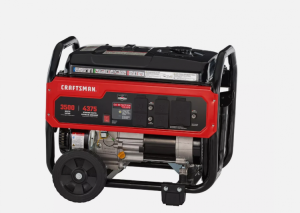
That's what a generator is for. A single blower needs a generator rated at least 2,000 watts. If you're running two blowers, or a water slide with a pump, or you want to plug in a snow-cone machine too, step up to a 3,500 to 4,000-watt generator so nothing is maxed out. (You never want a generator running at full capacity, because it overheats and dies.) We size and bring the generator for park and open-field bookings, fuel it, and keep it a safe distance from the kids, so "there's no outlet out here" is a non-issue for you.
One thing a generator doesn't solve is permission. Most Orlando-area parks require a permit and proof of insurance to set up an inflatable. We walk through that with you, so start with our Apopka park permit guide and our rundown on using a bounce house at a park.
Do water slides need electricity too?
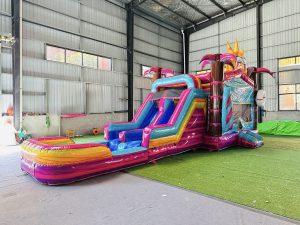
Yep, same idea. A water slide rental runs on the same kind of blower to hold its shape, plugged into a standard 120-volt outlet. The water itself comes from a regular garden hose, not electricity, so you're not pulling extra power for the splash. If it's a big dual-lane slide with two blowers, treat it like two inflatables: two circuits, or a bigger generator.
What we actually handle for you
Bottom line, powering the unit is our job, not your homework. Every bounce house rental we drop off comes with its own blower and heavy-duty cord. For a backyard party, all we need from you is one working outlet within about 50 feet. For a park or open field, tell us there's no power when you book and we'll bring a generator. That's it.
Planning a party in the Apopka or Orlando area and not sure what your spot can handle?
Tell us where it's happening →Key takeaways
- Bounce houses need continuous electricity. The blower runs the whole rental, or the unit deflates.
- A standard blower pulls about 1,000 watts (roughly a hair dryer's worth) on a normal 120-volt outlet.
- Give each blower its own dedicated circuit and keep it within about 50 feet on one heavy cord.
- No outlet? A 2,000-watt generator runs one blower; 3,500 to 4,000 watts covers two blowers or a water slide.
- We bring the blower, the cord, and the generator. You just point us to power or tell us it's a park.
Frequently asked questions
Do bounce houses use a lot of electricity?
No. A standard blower draws about 1,000 watts, similar to a hair dryer, running continuously. Over a typical four-hour party that's only a few kilowatt-hours, which costs pennies on a Central Florida electric bill.
How? many amps does a bounce house blower use?
Between about 7 and 14 amps depending on size: roughly 7 amps for a small or toddler unit, 9 for a standard unit, and up to 14 for a large combo. All run on standard 115 to 120-volt power.
Can I run two bounce houses on one outlet?
No. Each blower needs its own dedicated circuit. Two blowers sharing one circuit will trip the breaker and deflate both units. If you're renting two inflatables, plan for two separate circuits or a larger generator.
Can I use a long extension cord for a bounce house?
Use one heavy-duty (12- or 14-gauge) cord under about 50 feet, and never chain two cords together. Long or thin cords cause voltage drop that overheats the blower. If the outlet is farther than that, a generator is the safer call.
What size generator do I need for a bounce house?
At least 2,000 watts for a single blower. For two blowers, a water slide with a pump, or extras like a concession machine, step up to a 3,500 to 4,000-watt generator so it never runs at full capacity.
Can you set up a bounce house at a park with no power?
Yes, we bring a generator for parks and open fields. Just know that most Orlando-area parks also require a permit and proof of insurance, so check the park's rules (or ask us) before you book the date.
Tommie owns and runs To The Moon Bounce Co, delivering and setting up bounce houses, combos, and water slides for birthdays, church events, and community festivals across Apopka, Orlando, Winter Garden, and the surrounding Central Florida area.